Give customers a reason to come back
Bain Cup 2021 · Pagoda growth strategy by Kelun Wang & Team
A fruit retailer can add stores and still struggle to distinguish itself. If competitors also offer convenience, delivery, and attractive prices, what gives customers a reason to choose the brand—and return?
Our team’s submission to the 2021 Bain Cup Case Competition approached that question for Pagoda, the Chinese fruit-specialty chain. We connected market and customer research to store formats, city selection, sourcing, and membership design. The result was a growth proposal built around Fresh, Fashion, and Fun.1
This is a historical competition case, not a record of a commissioned Bain or Pagoda engagement. Store openings and future-year figures below are proposals and forecasts from the 2021 deck, not claims that those outcomes occurred.
Diagnose the opportunity before choosing a format
The presentation framed fruit retail as a growing market in which modern channels were gaining ground. Its approximate market estimates rose from RMB 750B in 2015 to RMB 1,000B in 2020, followed by a forecast of roughly RMB 1,500B in 2023.2
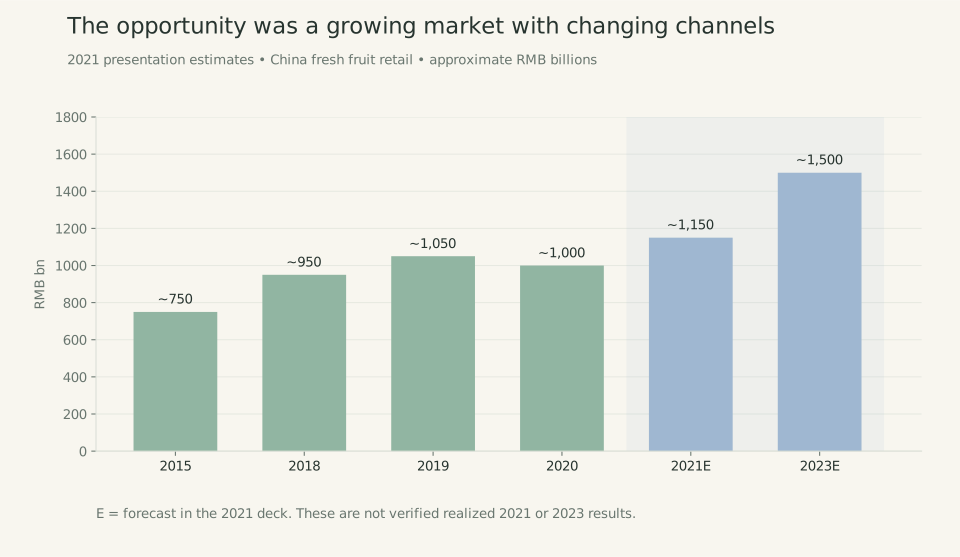
The strategic insight was about channels as much as market size. Online ordering offered convenience, while physical stores let customers inspect a product whose freshness and quality matter immediately. Our thesis was that an online-to-offline experience could combine those strengths rather than treating the store and the app as separate businesses.
A larger market does not automatically make an expansion profitable. Rent, labor, cold-chain costs, and spoilage can consume the benefit. The market analysis identified where to investigate; the store concept still had to earn its economics.
Compete for an occasion, not just a transaction
Customer research in the deck emphasized quality, freshness, and shopping experience. The purchase occasions ranged from everyday snacking and nutrition to gifting and lifestyle experiences. The materials cite surveys, interviews, expert input, public sources, and team analysis, but do not provide a full sampling protocol. I treat the profiles as directional research rather than population estimates.3
The competition analysis also distinguished national scale from local strength. Pagoda’s broad footprint did not remove the threat of regional chains. Meanwhile, fresh-food platforms and new-retail formats competed for the same customer’s convenience and attention. Being ahead of another fruit-specialty chain was therefore an incomplete definition of success.
That diagnosis led to a more specific positioning question: which customer occasions could Pagoda serve in a way that drew on its fruit expertise?
Make quality credible
Fruit standards, sourcing, freshness, and reliable handling support the promise.
Make the visit distinctive
Store design, presentation, and products fit lifestyle and gifting occasions.
Give participation a purpose
Workshops, customization, and membership experiences encourage engagement.
Design two stores for different jobs
The recommendation added two concepts alongside standard neighborhood stores. The Fruit Lab would make fruit expertise tangible through fresh juice, customization, workshops, and membership events. The City Exclusive Store would connect local fruit, city culture, distinctive packaging, and tourism.4
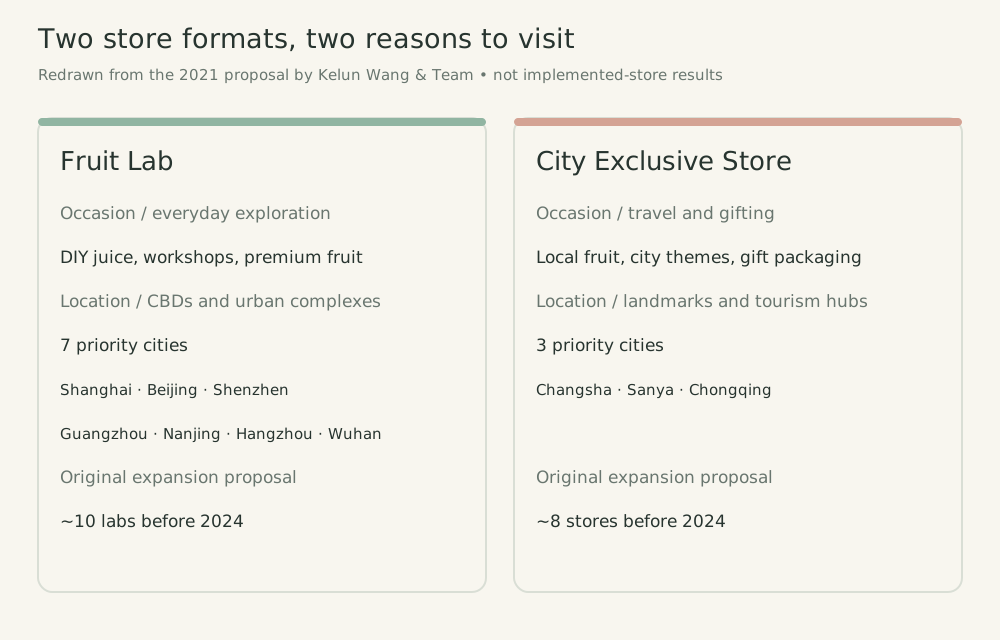
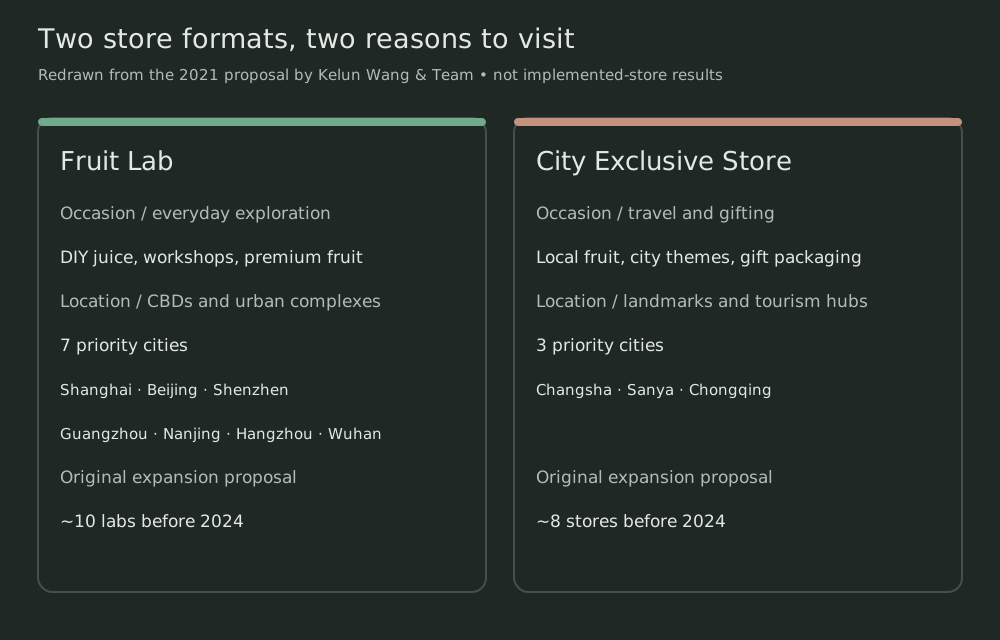
These concepts solve different problems. A Fruit Lab has to create repeat local demand; a tourist-oriented store has to convert a visit into a memorable purchase. Treating them as one generic premium format would hide differences in assortment, staffing, seasonality, and success metrics.
The deck proposed Shanghai and Changsha as initial testing locations, with approximately ten Fruit Labs and eight City Exclusive Stores before 2024. Its wider positioning included a RMB 60–80 selling-price range. These were design choices to test, not evidence of achieved prices or profitable expansion.
Separate city selection from site selection
A promising city is not automatically a promising storefront. Our proposal used two levels of screening.
| Decision | Fruit Lab | City Exclusive Store |
|---|---|---|
| City characteristics | Disposable income, economic scale, existing coverage | Tourist volume, destination appeal, social-media audience |
| Local setting | Central business districts, urban complexes, pedestrian shopping areas | Attractions and commercial areas with local character |
| Initial customer job | Discovery, customization, lifestyle participation | Regional discovery, gifting, a memorable travel purchase |
| Question for a pilot | Will local customers return at sustainable contribution? | Will visitor conversion cover the format’s seasonal costs? |
The first three rows summarize the deck’s logic. The pilot questions are my retrospective interpretation of how to make that logic testable. Existing coverage can provide awareness and logistical support, but it can also create cannibalization; a new store should add value beyond shifting revenue from a nearby outlet.
Connect the experience to the operating system
The proposal paired front-of-store changes with upstream integration, specialist growing bases, planting support, and cold-chain coordination. That connection matters because a premium experience fails if product quality varies or waste becomes too expensive.
The deck also proposed moving parts of the operating model toward direct ownership to improve control and support local innovation. The tradeoff is capital and management intensity. More control should be evaluated against the additional fixed costs and operating responsibility it brings.5
Membership was designed as another connection between physical and digital activity. The proposed Fruit Collection Book would color in regions on an in-app map when a customer bought regional fruit or visited a featured store. It was a way to turn a product’s origin into a reason to explore—and to connect that exploration with the next visit.
- 01 / DiscoverA local fruit or a featured store
Give the customer a recognizable occasion to engage.
- 02 / ParticipateA purchase, workshop, or visit
Connect the physical experience to a membership account.
- 03 / ContinueA collection and a relevant next offer
Use the proposed digital record to encourage another visit.
Turn the proposal into a learning sequence
The original roadmap spanned 2021–2026, starting with pilots and extending to store design, sourcing, operating changes, and CRM. I would preserve the sequence but add explicit evidence gates before expansion.6
| Pilot question | Measure | Why it matters |
|---|---|---|
| Does the experience attract useful demand? | Conversion, basket contribution, labor per order | Attention alone does not pay for the store |
| Does the customer return? | Repeat visits and contribution by customer cohort | Distinguishes a durable habit from an opening promotion |
| Is quality scalable? | Waste, stockouts, complaints, handling cost | Tests whether the sourcing promise survives operations |
| Does the program add value? | Incremental contribution against a suitable comparison | Separates new demand from discounts and cannibalization |
A compact way to express the gate is below. This is a new explanatory calculation for the article, not code or a quantified profit forecast from the competition submission.
pilot_contribution = (
    incremental_revenue * gross_margin
    - incremental_waste_cost
    - added_labor_and_occupancy
    - membership_and_promotion_cost
)
The definitions must be consistent: waste should only be deducted separately if the gross-margin input excludes it, and incremental revenue should account for displaced sales at existing stores. A phased pilot or credible comparison group would help test those effects before committing to a wider rollout.
The project brought together the parts of strategy that I find most useful: a clear customer occasion, a differentiated offer, a location logic, and an operating model that can support the promise. The next step is to let pilot economics determine which ideas deserve scale.
Sources and scope
The source is Growth Strategy for Pagoda, the 19-slide presentation by Kelun Wang & Team for the 2021 Bain Cup Case Competition. Charts and diagrams are redrawn for the website. Company comparisons and forecasts retain their historical context. The pilot metrics and contribution expression are retrospective extensions, identified separately from the original proposal.
Footnotes
Kelun Wang & Team, Growth Strategy for Pagoda, 2021 Bain Cup Case Competition, slides 1–2 and 12. Slide numbers here count every slide, including covers and agendas.↩︎
Slide 4, market overview. The deck cites Euromonitor, CCFA, analyst reports, and team analysis; figures are approximate source-slide values. Slides 5–6 discuss channels and operating models.↩︎
Slides 7–10, customer profiles and competition. Sample size and uncertainty are not documented sufficiently to treat the customer profiles as representative market estimates.↩︎
Slides 13–15, city selection, two store concepts, and product experiences. Approximate expansion counts and dates describe the 2021 proposal.↩︎
Slides 16–17, sourcing, operating model, sales, CRM, and Fruit Collection Book.↩︎
Slide 19, original 2021–2026 implementation timeline. The evidence gates and evaluation metrics in this article are later analytical suggestions.↩︎