Send fewer messages. Earn more.
Tuango · Mobile offer targeting and campaign profitability
Business Context
Tuango is a Chinese deal-of-the-day platform whose model resembles Groupon: it promotes discounted offers from local and national merchants and distributes those offers to customers through mobile apps. In the Tuango case, the company wanted to promote a karaoke deal to mobile users in Hangzhou who had shown interest in the category.
What makes the case more interesting than a standard response model is that the message itself is not free. Susan Liu, the newly appointed Chief Data Scientist for Tuango’s mobile marketing group, challenged an internal assumption that pushing offers through the app had essentially zero marginal cost. Her concern was behavioral rather than technical: if customers received too many irrelevant messages, they might block future deal notifications altogether and permanently weaken an important marketing channel.
That detail changes the problem from “who is likely to buy?” to a more useful business question:
Which customers should receive a message once the true cost of messaging is taken seriously?
The Decision Problem
The campaign followed a structured rollout design:
- Start with all mobile customers in Hangzhou who had shown interest in karaoke:
418,160customers. - Randomly sample
5%of them, or20,908customers, and send the deal to all of them. - Use the resulting response data to model purchase probability and order size.
- Apply the model to the remaining
397,252rollout customers. - Decide whether targeting improves profitability relative to messaging everyone.
That setup is appealing from an analytics perspective because it creates a clear bridge from experimentation to deployment. Rather than fitting a model in the abstract, I could evaluate whether a targeting rule would actually improve profit in the rollout population.
My Framing
I approached the case as a two-step targeting problem:
- Estimate the probability that a customer buys the karaoke deal.
- Compare that probability against a breakeven response threshold implied by campaign economics.
This framing matters because a prediction is only useful when it changes a decision. If messaging costs were truly zero, it might make sense to contact everyone. But once the app-channel cost is acknowledged, the model needs to support a selective rollout policy.
Data And Features
The response and rollout workflow uses pandas and statsmodels, with supporting model interpretation in the course notebook.
The customer history variables included:
recencyfrequencymonetaryagegendermusic
I first converted purchase response into a binary modeling target:
import numpy as np

tuango["buyer_yes"] = np.where(
    tuango["buyer"] == "yes", 1,
    np.where(tuango["buyer"] == "no", 0, np.nan)
)
In the modeling sample, the average purchase rate was about 9.66%, and among buyers the average order size was about 3.94 karaoke sessions.
Modeling Response
I used logistic regression to estimate purchase propensity for the offer:
import statsmodels.formula.api as smf

df_model = tuango.loc[tuango["test"] == 1].copy()
formula = (
    "buyer_yes ~ recency + frequency + monetary + age "
    "+ C(gender) + C(music)"
)
clf = smf.logit(formula=formula, data=df_model).fit()
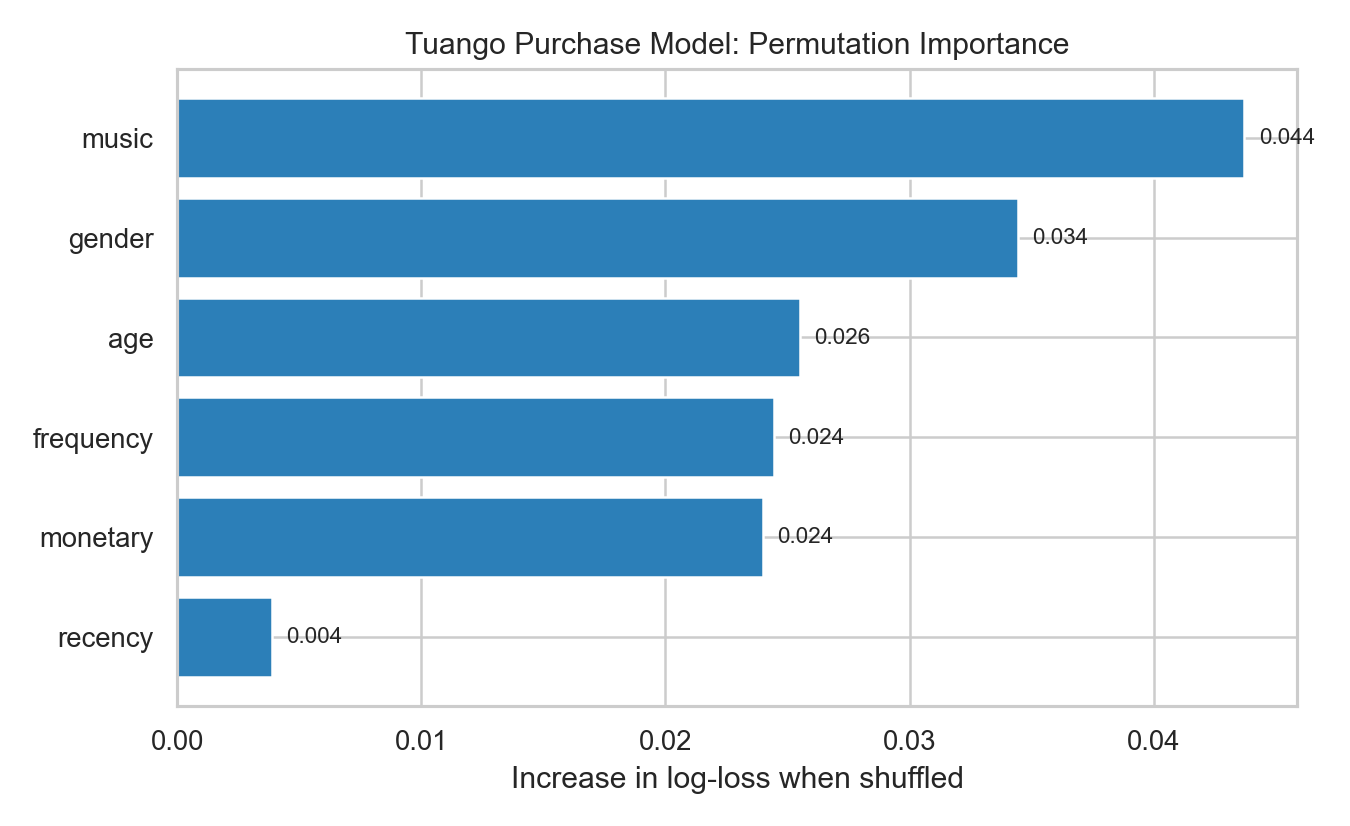
One useful outcome from the model interpretation stage was that monetary and music emerged as the most important predictors of purchase behavior. That finding is intuitive: customers with stronger historical spend and clear category affinity were more likely to respond to the karaoke promotion. By contrast, recency added relatively little once the richer customer history variables were already in the model.
I also estimated a linear regression for order size among buyers, but that second model turned out to be much weaker. In practical terms, I found that predicting whether someone would buy was far easier than predicting how much they would buy conditional on response. That asymmetry shaped my interpretation of the case: purchase incidence was where the strongest business signal lived.
Why The 9 RMB Cost Matters
The case background explains why Tuango treated 9 RMB as the marginal cost of sending one additional message. That figure was not just an operational messaging fee. It reflected the expected long-run cost of customer fatigue and opt-out behavior in the mobile channel.
This is the most important strategic insight in the case. Once messaging has a real economic cost, the correct decision rule is not “contact everyone with nonzero probability.” Instead, the campaign should contact only customers whose expected profit exceeds that marginal cost.
Using the observed mean order size and Tuango’s fee structure, I calculated a breakeven response rate of about 9.32%.
# Equivalent expression of the case economics.
avg_ordersize_yes = df_model.loc[df_model["buyer"] == "yes", "ordersize"].mean()
margin = 0.50 * 49 * avg_ordersize_yes
breakeven = 9 / margin
That threshold became the operational cutoff for the rollout.
The table below is the key decision summary I would show to a marketing manager before launch:
| Strategy | Customers Messaged | Expected Response Rate | Expected Profit (RMB) | ROME |
|---|---|---|---|---|
| Message Everyone | 397,252 | 9.66% | 130,019 | 3.6% |
| Logistic Targeting | 174,126 | 14.04% | 810,139 | 51.7% |
What Happens If Tuango Targets Everyone?
The baseline policy is simple: send the karaoke offer to all 397,252 remaining rollout customers.
Under that strategy, the projected economics were:
- messages sent:
397,252 - projected profit: about
130,019 RMB - projected return on marketing expenditure: about
3.6%
That is profitable, but only marginally so. A strategy like this risks overspending on many low-value customers whose response probability is barely above zero.
What Happens Under Model-Based Targeting?
I then used the logistic model to target only customers whose predicted response probability exceeded the breakeven threshold. That reduced the outreach list to 174,126 customers.
The targeting step itself was straightforward: score the rollout audience, compare each score with the breakeven rate, and keep only the customers whose expected response exceeded the economic hurdle.
# Apply the fitted model; keep the training categorical encodings.
rollout_scored = tuango.loc[tuango["test"] == 0].copy()
rollout_scored["pred_yes"] = clf.predict(rollout_scored)
targeted_rollout = rollout_scored.loc[rollout_scored["pred_yes"] > breakeven]
The model-based targeting policy produced much stronger projected economics:
- messages sent:
174,126 - projected response rate: about
14.04% - projected profit: about
810,139 RMB - projected return on marketing expenditure: about
51.7%
The notebook uses two different order-size summaries here. The 9.32% cutoff uses the mean of 3.941 sessions across all pre-test buyers. The 810,139 RMB projection uses about 3.970 sessions among pre-test buyers who also meet the targeting rule. Keeping the overall buyer mean for both policies would instead project about 792,885 RMB for targeting. The selection remains the same; the revenue assumption changes.
eligible_buyers = (df_model["buyer"] == "yes") & (clf.predict(df_model) > breakeven)
selected_order_mean = df_model.loc[eligible_buyers, "ordersize"].mean()
expected_profit = (
    targeted_rollout["pred_yes"].sum() * 0.50 * 49 * selected_order_mean
    - len(targeted_rollout) * 9
)
The business logic is straightforward: send fewer messages, but send them to people who are much more likely to respond profitably.
Retrospective Policy Evaluation
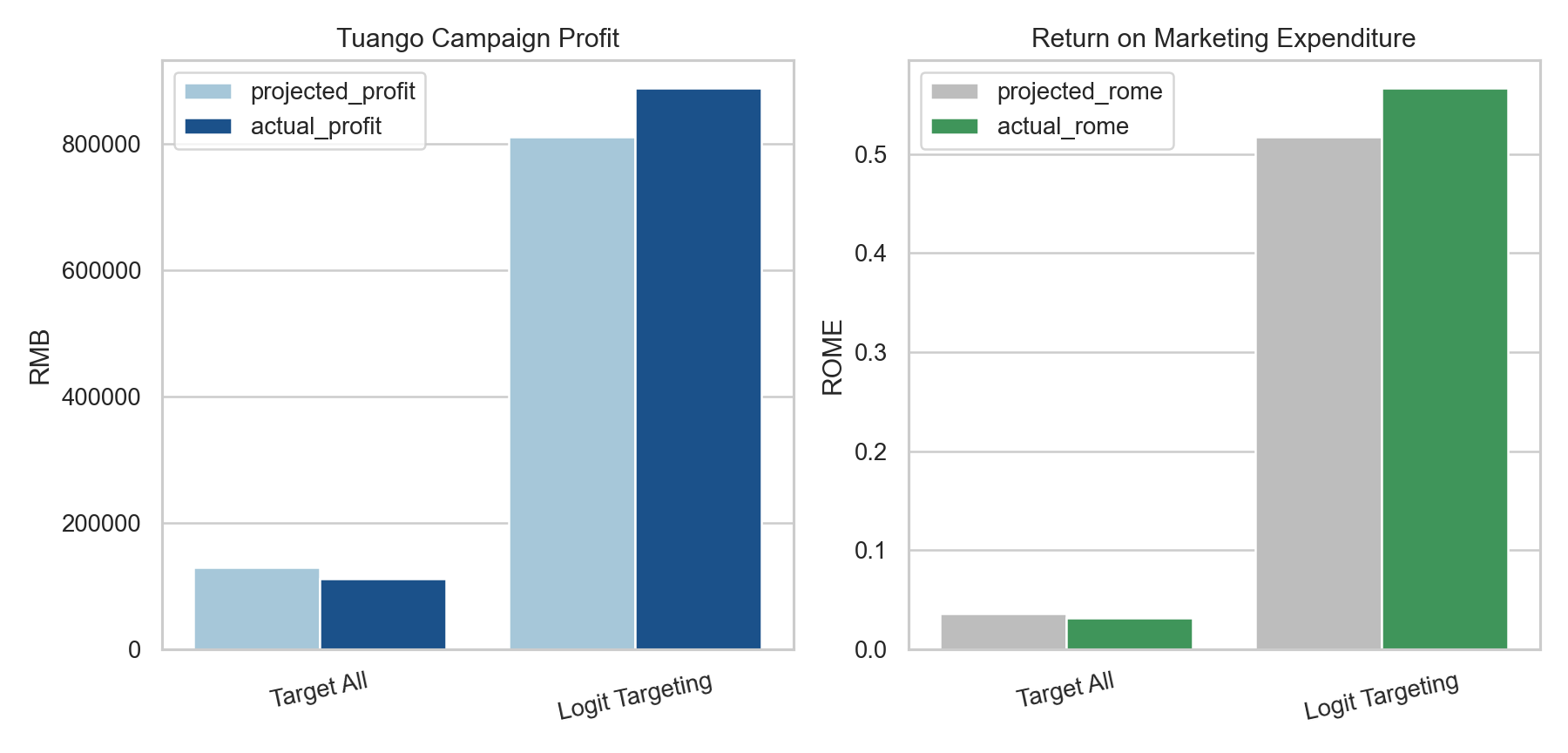
The case supplied outcomes for all remaining customers because everyone received the offer. I applied the previously fitted targeting rule to tuango_post.parquet, restricted evaluation to test = 0, and compared full-audience economics with the revenue and assumed contact cost for the subset the rule would have selected. This is retrospective policy accounting on observed case outcomes.
That comparison is the most convincing result in the project:
Target All      profit ≈ 111,712.5 RMB   rome ≈ 0.031
Logit Targeting profit ≈ 887,423.0 RMB   rome ≈ 0.566
The selected subset has stronger economics in these data. This supports the targeting rule under the case assumptions; it is not a separate trial in which customers were randomized between the two rollout policies.
Two numbers summarize the difference:
- calculated policy profit: roughly
112k RMBfor everyone versus887k RMBfor the selected subset - calculated marketing return: about
3.1%versus56.6%
That is the kind of lift that makes a targeting model operationally worthwhile.
My Interpretation
What I like most about this case is that the final answer is not really “logistic regression works.” The more important conclusion is that a campaign model should be evaluated against decision economics, not only against statistical fit.
In this case, three ideas mattered:
- customer targeting should reflect channel cost, not just response likelihood
- purchase probability was much more predictable than order size
- model deployment should be judged on realized profit, not only in-sample calibration
If I were communicating this to a growth or CRM team, my recommendation would be clear: keep the mobile channel selective, use the model to filter the audience, and treat irrelevant messaging as a real cost because it degrades long-term customer contactability.
Why This Belongs In My Portfolio
This project reflects the kind of analytics work I enjoy most: turning a real business constraint into a decision rule that improves profit. It sits at the intersection of marketing analytics, experimentation, customer targeting, and model interpretation.
It also reflects an approach I want my portfolio to show consistently: not just building a model, but asking whether the model changes what the business should do.
Scope and Interpretation
The projected figures use the case’s 9 RMB messaging-cost assumption. The post-data comparison uses observed purchases and the assumed 9 RMB economic cost per contact, which includes estimated channel fatigue rather than only cash expenditure. It does not measure the causal effect of withholding messages or independently deployed commercial results. Its relevance to another campaign depends on customer behavior and channel economics remaining comparable.
Technical Notes
- Tools:
Python,pandas,statsmodels,pyrsm, plotting libraries - Methods: logistic regression, permutation importance, threshold optimization, rollout evaluation